I am a gaming addict. I have played computer games since I was 6. I grew up with them. I developed my own ones.
I am now into World of Warcraft. This is a 100% online game and there are now over 4million users online. For me I had to actually plan my life around this game and impose boundaries. There are 2 stories with this game that will impress upon you how intense it is. 1) There was a Korean guy that played the game so long and didnt take care of himself that he died at his computer. 2) There were 2 Japanese guys that journeyed through the world to get a sword, one of the guys sold the sword and the other guy was so annoyed he went over to his house and stabbed the guy to death. Yeah.. pretty intense. I am not at that level but do like the game a lot.
This is a massive trend to games and will continue into the future. It is a honey pot of keen users all in one place. I am sure marketers, corporates and entrepreneurs are going to tap into this. There has been some already with characters, items and money from within the game being auctioned off on Ebay!
Something I have noticed more and more happening out there are some of the big online players making large purchases of online space similar to this gaming honeypot. Example Yahoo purchasing Konfabulator, http://upcoming.org/ and flikr.com. The strategy here has been for Yahoo to try and take advantage of their huge libraries of content in other ways.
Googles purchase of Blogger has been a great way for it to sell more adsense ads. There is a button inside this program that allows you to ad advertisements to your blog. I have felt that this might detract from this blog for now and didnt want to flog the whole marketing thing too much.
I think there will be more purchases of these kinds of honeypots as more and more bees buzz to them!
Tuesday, February 14, 2006

Tuesday, February 7, 2006
How to select an online marketing agency?
We are in the middle of some negotiations with current clients about their 2006 year budgets. I have a few tips I would like to share with marketing managers and decision makers alike:
1. Why online? - When selecting how much budget to spend online you need to understand why are you online in the first place? Why does your business go online. Strip everything back. Where is the business going to make money out of being online? If you have some specific reasons write these down and send them to your agency. If you dont know the reasons ask your agency to present to you why you should be online.
2. How much do you spend online? - Ask your agency how much they think you should spend. Or better say what could I get for $xxx. Tell them to present what we could get for that money. The best scenario would be if you said, these are the reasons that we want to be online (build brand, generate awareness, leverage sponsorships, make sales, generate leads etc...) here are the targets we want to achieve. What do you suggest to do this and how much do you think we should spend. If you provided a budget and what targets of value you wanted to achieve an agency could put together the answer to this problem. Spend $y, get these results.
3. What criteria make a good online marketing agency?
1. Why online? - When selecting how much budget to spend online you need to understand why are you online in the first place? Why does your business go online. Strip everything back. Where is the business going to make money out of being online? If you have some specific reasons write these down and send them to your agency. If you dont know the reasons ask your agency to present to you why you should be online.
2. How much do you spend online? - Ask your agency how much they think you should spend. Or better say what could I get for $xxx. Tell them to present what we could get for that money. The best scenario would be if you said, these are the reasons that we want to be online (build brand, generate awareness, leverage sponsorships, make sales, generate leads etc...) here are the targets we want to achieve. What do you suggest to do this and how much do you think we should spend. If you provided a budget and what targets of value you wanted to achieve an agency could put together the answer to this problem. Spend $y, get these results.
3. What criteria make a good online marketing agency?
- Understand and can supply all aspects of online marketing (search, websites, email, banners, affiliate, games, copywriting)
- Proactively make suggestions upon new and different ways to market online
- Apply marketing principles to online marketing
4. What criteria are bad qualities?
- Are only specialised in one aspect of online marketing. Usually companies suggest that they are an online marketing agency if they can build a website. Online marketing agencies are exceptionally specialised and the science of online marketing is complex. This is the same as saying that a heart surgeon can cut your heart so lets give them a go at your brain.
- Wait for briefs before they do anything
- Suggest that print and offline marketing are the drivers customers and the website only really supports this.
Thursday, February 2, 2006
What are some good methods for avoiding spam filters?
We often get asked about any simple steps that can be taken to reduce the likelihood of your campaign being flagged as spam by your recipient's ISP, or your recipients themselves. Even when you're sending an email campaign to subscribers who opted-in, your email can still be flagged as spam by overzealous spam filters. Simply using the word "free" in an email message can often land you in the spam heap.
Listed below are a number of simple tips and techniques you should consider when writing and designing your campaigns:
Most of the popular and more advanced spam filters out there use these and a whole bunch of other criteria to score your campaign. For example, check out the range of filtering rules for SpamAssassin, one of the most popular spam filters on the web.
Ultimately, the most important thing you can do is adhere to best practices for email marketing. Gain permission, compose relevant content, and deliver messages according to the customer's needs, wants, and preferences.
Refernced from
by
Listed below are a number of simple tips and techniques you should consider when writing and designing your campaigns:
- Keep sender addresses as short as possible.
- Avoid continuous sending of messages to full or invalid mailboxes. You can do this by tweaking your bounce handling settings for each subscriber list.
- Minimize the use of these words and phrases in the subject line, message body, sender address, and reply-to address:
Use of the word Free (although "free" tends to have more leeway than most other trigger words), $$, XXX, sex or !!! (any excessive punctuation)
Subject contains "Double Your", "?", "For Only" or "Free Instant".
TOO MANY CAPS IN THE SUBJECT LINE
Email contains at least 70 percent blank lines
The from field appears to not contain a real name, ends in numbers or contains the word friend.
The reply-to field is empty
The email claims not to be spam
The email contains excessive images without much text - Monitor new subscribers in your lists. Set suspicious "spamflag" addresses such as "abuse@" or "marketerspam@" as Inactive subscribers.
Most of the popular and more advanced spam filters out there use these and a whole bunch of other criteria to score your campaign. For example, check out the range of filtering rules for SpamAssassin, one of the most popular spam filters on the web.
Ultimately, the most important thing you can do is adhere to best practices for email marketing. Gain permission, compose relevant content, and deliver messages according to the customer's needs, wants, and preferences.
Refernced from
by
Wednesday, February 1, 2006
Search engine optimisation tip #2 - Pagerank
Pagerank is a concept developed by Larry Page one of the founders of Google. Essentially Larry was trying to find a way to categorise all of the university papers and doctrines into some sort of importance. He used the concept that if a paper referenced another paper it would mean that the paper that had been referenced was important. The more papers that referenced that paper the more important and credible it was. In the same way the papers that these papers referenced gained importance in the same way. And so on. Thus if a paper that was very important made reference to another paper this would be worth more in the scale of things. Larry essentially needed to crunch some serious numbers and that is where his partner Sergey Brin comes in. Sergey was the mathmatician who worked out an algorithm to crunch this problem down and make some sense of it.
Thus they then replaced these doctrines with the entire web and references with links and crunched the entire web universe down. They then stored this data and displayed it as you see it today.
Thus Pagerank (Larry Pagerank) is all about the number of websites that link to your website. Aswell as a ranking of how those websites that link to you are. I.e. depending on the pagerank of the websites that link to you this will determine your pagerank.
How to use this info:
1. Get more websites to link to you that have high pagerank.
2. Get more links (references) to your website.
Need more info just email or comment.
Thus they then replaced these doctrines with the entire web and references with links and crunched the entire web universe down. They then stored this data and displayed it as you see it today.
Thus Pagerank (Larry Pagerank) is all about the number of websites that link to your website. Aswell as a ranking of how those websites that link to you are. I.e. depending on the pagerank of the websites that link to you this will determine your pagerank.
How to use this info:
1. Get more websites to link to you that have high pagerank.
2. Get more links (references) to your website.
Need more info just email or comment.
Tuesday, January 31, 2006
Yahoo7 launches new portal
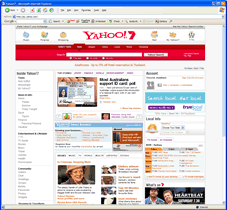
Yahoo has always played second fiddle to Ninemsn ever since it launched. Ninemsns greater and more relevant local content tied in with its huge television and magazine promotions have given it more traffic. More traffic leads to more advertising. More advertising means more cash. More cash means a better, fresher website.
Yahoo unlike in other countries is a small player in Australia although its new initiative to integrate channel 7 content and info into the website will surely put the stick into Ninemsn.
Yahoo in the early days was a dominant player with their directory structure of providing content to web "newbies". As the web user has become more and more educated this directory structure has not been as useful because of the weird and wacky requirements for information from the more informed web user. Putting a big Search bar infront of a user these days does confuse them it excites them.
I am keen to see how this changes the online media space and perhaps some day you will see TV media sales packaged with media space on their websites?!?
Comments appreciated.
Monday, January 30, 2006
Search engine optimisation tip #1 - Page titles
Page titles are a key consideration by Google when looking at your website as to what exactly the page is all about. The key is to name your titles with the keywords you are looking to optimise the page for.
Example:
www.lasik.com.au
Laser eye surgery from Laser Sight Centres
Pages throughout this website change title as you move from different content areas. This is good SEO since you are customising each page to particular keywords and not just targetting your generic words.
This also comes back to the principle of 1 page for 1 keyword.
Any questions or comments please post.
N.B. This is a forum I read to get some new insights and opinions to our own search engine optimisation http://www.searchengineforums.com/
Example:
www.lasik.com.au
Laser eye surgery from Laser Sight Centres
Pages throughout this website change title as you move from different content areas. This is good SEO since you are customising each page to particular keywords and not just targetting your generic words.
This also comes back to the principle of 1 page for 1 keyword.
Any questions or comments please post.
N.B. This is a forum I read to get some new insights and opinions to our own search engine optimisation http://www.searchengineforums.com/
Thursday, January 19, 2006
What works well online
I have lots of questions and thoughts about what companies actually work online. My answer to this is really based upon objectives and definition of what you mean by works.
Products that work well online are usually ones that dont need to be seen or felt or touched or tried on etc.. low human interaction is required. Good examples of this are:
Products that work well online are usually ones that dont need to be seen or felt or touched or tried on etc.. low human interaction is required. Good examples of this are:
- Books (Amazon)
- Computers (Dell, newegg.com, techbuy)
- Credit cards (Virgin Money)
- Pharmaceuticals (www.yourchemistshop.com.au)
- Flowers (Roses only)
- gift baskets (www.thebasketcase.com.au )
- Insurance (HCF, NIB, NRMA, QBD)
- Real Estate (realestate.com.au)
- Cars (carsales)
- Second hand goods and auctions (ebay)
- Music (mp3.com.au, hmv, virginmega.com)
- DVD rental (netflix)
- Mortgages (aussies, wizard)
- Software (sourceforge)
- Newspapers (news.com.au, smh, ninemsn)
- Dating (rsvp, match.com, lavalife)
- Pornography and sex toys (... too many .. adultshop)
- Gambling (Pokerparty, Betfair)
- Perfume
- Jobs (careerone)
- Stock trading (etrade, all banks commsec, westpac, st george)
- electronics (xbox, tvs, dvd, cameras)
- Digital photo processing
- Travel (lastminute, expedia, .. too many.. this is huge.)
- Internet access
- Web hosting (Webcentral, ozhosting)
- Jewellery
- Swimwear and lingerie
- Games (Software and real life)
- Free stuff (emailcash)
- Distress inventory (lastminute,Overstock)
- Cosmetics (strawberrynet)
- Ringtones and other mobile (blueskyfrog, jamster)
There are many more categories and many more to be added.
Some key criteria which I think work well are but are not necessarily require to be together:
- Customer need information about the product
- Customers are price conscious if you have the best price online customers will buy it.
- The product is digital in nature or primarily based on technology
- The product is information. Reports, ebooks etc..
Subscribe to:
Posts (Atom)